The cost of studying medicine in the Czech Republic is one of its biggest attractions: tuition for the six-year English-taught Doctor of Medicine (MUDr) runs from about €12,000 to €24,250 a year depending on the faculty, with living costs of roughly €500–800 a month — far below the UK, USA or Ireland. Across the whole degree, an all-in budget of around €110,000–200,000 covers tuition and living, for an EU-accredited, globally recognised qualification. This 2026 guide breaks down every cost — tuition by university, living expenses, accommodation, one-off fees and the full six-year total — in five currencies (EUR, INR, USD, GBP and AED).
Cost overview
The headline on the cost of studying medicine in the Czech Republic is value: a world-class, EU-accredited medical degree for a fraction of what it costs in the UK, USA or Ireland, or at a private medical college in India. The two main components are tuition (€12,000–24,250 a year, depending on faculty) and living costs (€500–800 a month), with some one-off administrative expenses on top. There are no hidden surprises: the figures are transparent and, by international standards, very reasonable.
What makes the country's value proposition distinctive is that you are not trading down on quality to save money. The degree is EU-accredited and globally recognised, the universities are genuinely respected (Charles University ranks in the world's top 2%), and the clinical training is excellent — yet the price is a fraction of the Anglophone alternatives. This is quite different from choosing the absolute cheapest destination and accepting a weaker reputation; here, the moderate cost buys a strong, portable qualification. That combination of reasonable price and genuine quality is the essence of the value behind the cost of studying medicine in the Czech Republic, and it is why so many international students consider it money well spent.
Importantly, your total cost depends heavily on two choices: which faculty you attend (the regional universities cost roughly half what Charles University's Prague First Faculty does) and which city you live in (Prague is the priciest; Olomouc, Ostrava, Pilsen and Hradec Králové are cheaper). By choosing carefully, you can keep the cost of studying medicine in the Czech Republic toward the lower end of the range. This guide breaks every element down so you can budget precisely, and our complete guide to studying medicine in the Czech Republic sets the costs in their full context.
Budgeting your first year
The first year is the most expensive, because several one-off costs land alongside the recurring ones. In your first twelve months you pay the first year's tuition, the application and entrance-exam fees, nostrification and translation costs, the visa, a year of health insurance, an accommodation deposit (for private rentals), flights, and setup costs for furnishing and equipping yourself. Together these front-loaded expenses make year one noticeably heavier than the years that follow.
The practical implication is to budget extra for the first year and to arrive with a financial buffer covering at least the first two to three months of living costs on top of tuition. After the initial setup, the cost of studying medicine in the Czech Republic settles into a predictable rhythm of annual tuition plus monthly living expenses. Planning specifically for the heavier first year — rather than assuming every year costs the same — prevents early financial stress, and it is one of the first things EHEC helps families map out when budgeting for the degree.
A useful exercise is to draw up a year-one budget separately from your ongoing annual budget. The year-one figure should include the first tuition instalment, all the one-off admission, nostrification, visa and insurance costs, the accommodation deposit, flights, setup and the living buffer; the ongoing annual figure is then simply tuition plus twelve months of living costs. Seeing the two side by side clarifies exactly how much you need available at the outset versus each subsequent year, which makes arranging funds (whether savings, family support or a loan tranche) far easier. This kind of clear, staged budgeting removes much of the anxiety around the cost of studying medicine in the Czech Republic, turning a large, intimidating total into a manageable, predictable plan.
Payment schedules & methods
Understanding how and when you pay helps with cash-flow planning. Tuition for the cost of studying medicine in the Czech Republic is generally paid per academic year (some faculties allow per-semester payment), due before or at enrolment. Faculties publish fees in euros or Czech crowns (CZK), and several — Masaryk among them — offer international payment platforms (such as Convera) that let non-EU students pay by bank transfer, card or local methods without heavy international transaction charges.
It is worth confirming each faculty's payment deadlines and penalties — late tuition payment can incur charges at some universities. Budgeting for the annual tuition instalment well ahead of its due date, and understanding the accepted payment methods, keeps the financial side smooth. These mechanics are a small but practical part of managing the cost of studying medicine in the Czech Republic, and EHEC helps students understand each faculty's specific payment schedule so nothing is missed or paid late.
Tuition by university
Tuition is the largest cost, and it varies considerably by faculty. Here are indicative 2026 annual fees for English-taught General Medicine, in all five currencies (confirm current figures with each university).
| University / faculty | EUR | INR | USD | GBP | AED |
|---|---|---|---|---|---|
| University of Ostrava | €12,000 | ₹10.8L | $12,960 | £10,200 | AED 48,000 |
| Palacký University (Olomouc) | €12,500 | ₹11.25L | $13,500 | £10,625 | AED 50,000 |
| Masaryk University (Brno) | €15,100 | ₹13.59L | $16,308 | £12,835 | AED 60,400 |
| Charles — Pilsen | €15,600 | ₹14.04L | $16,848 | £13,260 | AED 62,400 |
| Charles — Hradec Králové | €15,795 | ₹14.22L | $17,059 | £13,426 | AED 63,180 |
| Charles — Second Faculty (Prague) | €16,800 | ₹15.12L | $18,144 | £14,280 | AED 67,200 |
| Charles — First Faculty (Prague) | €24,250 | ₹21.83L | $26,190 | £20,613 | AED 97,000 |
The regional faculties — Ostrava and Palacký — are the most affordable at around €12,000–12,500, while Charles University's prestigious First Faculty in Prague tops the range at €24,250. The mid-range (Masaryk, Charles Pilsen, Hradec Králové and the Second Faculty) sits between €15,100 and €16,800. So the single biggest lever on the cost of studying medicine in the Czech Republic is your choice of faculty — over €12,000 a year separates the cheapest from the most prestigious.
A note on currency: several faculties publish their fees in Czech crowns (CZK) rather than euros (commonly around CZK 300,000–450,000 per year), so the euro figures above are approximate and will shift slightly with exchange rates. When budgeting, it is wise to allow a small margin for currency movement, particularly if you are converting from rupees, dollars, pounds or dirhams. The faculties that offer international payment platforms make the conversion and transfer straightforward, but the underlying fee is set in crowns at those universities. Keeping an eye on the exchange rate and building in a little headroom ensures the cost of studying medicine in the Czech Republic holds no nasty currency surprises when each year's tuition falls due.
Six-year tuition
Multiplied across the six-year degree, tuition becomes the dominant cost. Here is the total tuition over the programme by tier, in all five currencies.
| Six-year tuition (total) | EUR | INR | USD | GBP | AED |
|---|---|---|---|---|---|
| Lower (Ostrava / Palacký) | €72,000–75,000 | ₹64.8L–67.5L | $77,760–81,000 | £61,200–63,750 | AED 288,000–300,000 |
| Mid (Masaryk / Charles Pilsen, Hradec, 2nd Fac.) | €90,600–100,800 | ₹81.5L–90.7L | $97,848–108,864 | £77,010–85,680 | AED 362,400–403,200 |
| Higher (Charles First Faculty, Prague) | €145,500 | ₹1.31Cr | $157,140 | £123,675 | AED 582,000 |
This shows the long-term impact of the faculty choice: studying at a regional university rather than Charles's First Faculty can save over €70,000 in tuition across the degree. Of course, the more expensive faculties carry greater prestige, so it is a genuine trade-off rather than a simple matter of cheapest-is-best. Either way, even the highest six-year tuition for studying medicine in the Czech Republic remains well below the cost of a UK or US medical education.
It is worth pausing on what that €70,000-plus difference represents, because it is substantial. For a student to whom prestige matters most — perhaps with ambitions toward competitive residencies where a renowned alma mater helps — the premium for Charles University's First Faculty may be worth paying. For a student focused on becoming a well-trained, recognised doctor at the lowest sensible cost, a regional faculty delivers the same EU-accredited MUDr for far less. Both are legitimate choices; the key is to decide consciously rather than by default. Since this single decision moves the total cost of studying medicine in the Czech Republic by tens of thousands of euros, it deserves careful thought early in the process, weighing your budget against how much you value the prestige premium.
Why tuition varies
It is worth understanding why the cost of studying medicine in the Czech Republic varies so much between faculties. The main driver is prestige and demand: Charles University's First Faculty in Prague is the oldest, largest and most renowned medical school in the country, and its fees reflect that standing and the strong demand for places. The regional universities — Ostrava (founded 1991) and Palacký (in Olomouc) — set lower fees, partly to attract students and partly reflecting lower local costs.
Location plays a part too: Prague, as the capital, commands premium fees and living costs, while the regional cities are cheaper across the board. Faculties also differ in facilities and reputation, which feeds into pricing. The practical takeaway is that you can choose your point on the price-prestige spectrum: a regional faculty for maximum affordability, Charles Prague for maximum prestige, or the mid-range for a balance. This flexibility is one of the appealing features of the cost of studying medicine in the Czech Republic, and EHEC helps students find the faculty that best matches their budget and ambitions.
One reassuring point: the quality of the degree does not vary with the fee. Every faculty awards the same EU-accredited MUDr, follows the same European standards, and produces graduates eligible for the same international licensing pathways. A cheaper regional faculty is not a "lesser" degree — it is the same qualification at a lower price, reflecting demand, location and prestige rather than educational quality. So a budget-conscious student choosing a regional university is not compromising on the recognition or validity of their degree, only on the prestige premium and the city. Understanding that the fee reflects positioning rather than quality is liberating when weighing the cost of studying medicine in the Czech Republic, because it means affordability and a fully recognised degree go hand in hand.
Monthly living budget
Beyond tuition, living costs are the second major element. In the Czech Republic, a student typically spends €500–800 a month all-in (more in Prague, less in the regional cities). Here is a representative monthly budget in all five currencies.
| Monthly item | EUR | INR | USD | GBP | AED |
|---|---|---|---|---|---|
| Accommodation (dorm/shared) | €150–450 | ₹13,500–40,500 | $162–486 | £128–383 | AED 600–1,800 |
| Food & groceries | €150–200 | ₹13,500–18,000 | $162–216 | £128–170 | AED 600–800 |
| Transport (student pass) | €6–20 | ₹540–1,800 | $6–22 | £5–17 | AED 24–80 |
| Utilities & internet | €50–170 | ₹4,500–15,300 | $54–184 | £43–145 | AED 200–680 |
| Health insurance | €20–60 | ₹1,800–5,400 | $22–65 | £17–51 | AED 80–240 |
| Personal & leisure | €80–150 | ₹7,200–13,500 | $86–162 | £68–128 | AED 320–600 |
| Total | €500–800 | ₹45,000–72,000 | $540–864 | £425–680 | AED 2,000–3,200 |
This is excellent value for Europe — living costs in the regional cities rival the cheapest in the EU, and even Prague is more affordable than most Western European capitals. Living in a dormitory and cooking at home keeps you near the lower end; a private flat and a busy social life push you higher. Either way, living costs are a manageable part of the cost of studying medicine in the Czech Republic.
It helps to think of the monthly budget as having a fixed core and a flexible margin. The fixed core — accommodation, food, transport, utilities and insurance — is largely unavoidable and lands at the lower-to-middle of the range for a careful student. The flexible margin — eating out, travel, social life and personal spending — is where you control whether you sit at €500 or €800 a month. Students who prioritise saving lean on dormitories, home cooking and the cheap transport pass, keeping the core low and the margin modest; those who want a fuller social life budget more. Understanding which costs are fixed and which are discretionary is the key to controlling the cost of studying medicine in the Czech Republic month to month.
Accommodation costs
Accommodation is the biggest single living expense, with three main options. Here is what each costs per month, in all five currencies.
| Accommodation (per month) | EUR | INR | USD | GBP | AED |
|---|---|---|---|---|---|
| University dormitory (kolej) | €150–300 | ₹13,500–27,000 | $162–324 | £128–255 | AED 600–1,200 |
| Room in a shared flat | €250–450 | ₹22,500–40,500 | $270–486 | £213–383 | AED 1,000–1,800 |
| Private studio / flat | €400–650 | ₹36,000–58,500 | $432–702 | £340–553 | AED 1,600–2,600 |
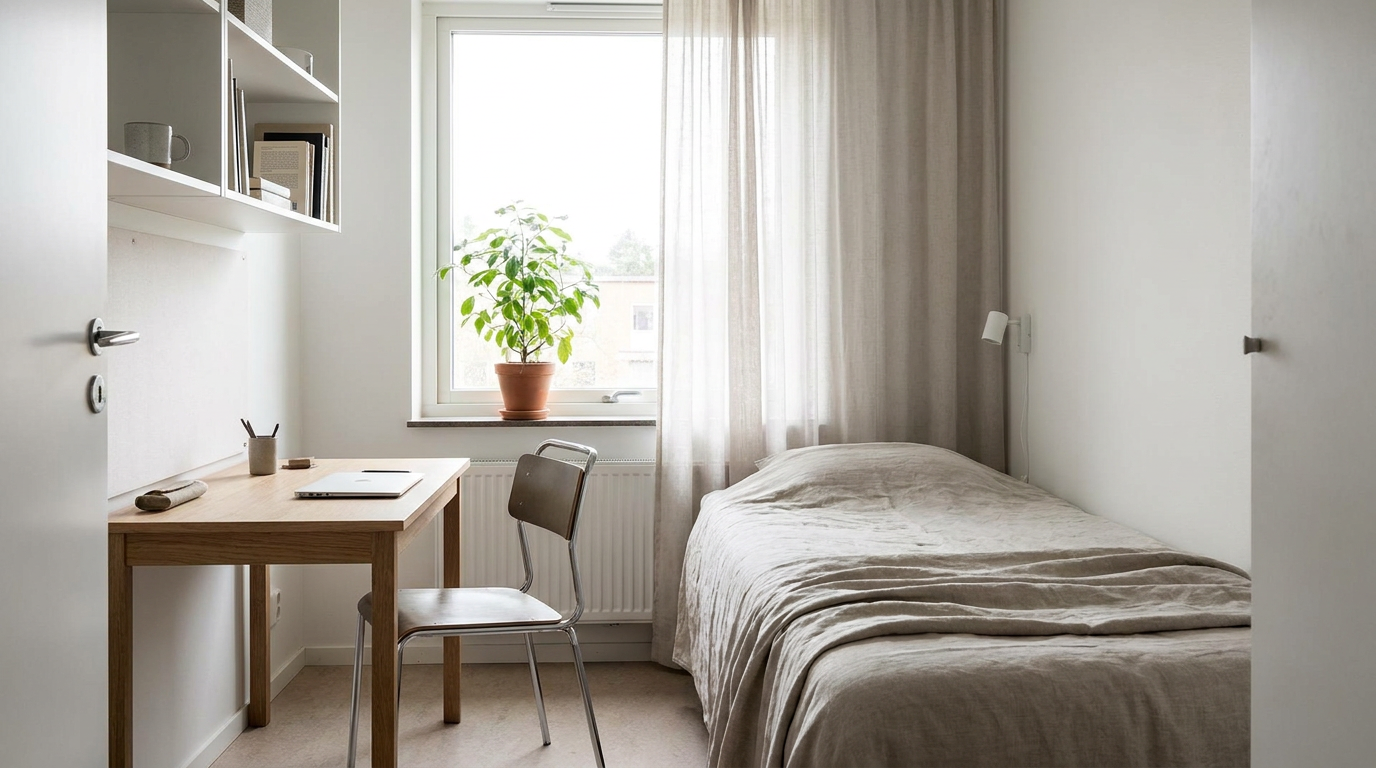
The cheapest and most sociable option is a university dormitory (kolej) at €150–300 a month, often with utilities included — great for first-years. A room in a shared flat (€250–450) offers more independence, while a private studio (€400–650) gives full privacy at a premium. Private rentals add utilities of roughly €120–170 a month and usually a deposit. Choosing a dormitory is the single most effective way to reduce the cost of studying medicine in the Czech Republic, especially in pricier Prague.
A few practical points on housing. Dormitory places can be limited and allocated early, so apply promptly through the university — they are the cheapest option and the best for making friends in first year, even if standards are basic. When looking for a private rental, it helps to view places in person or with trusted assistance to avoid scams, and to budget for the upfront deposit (usually one to two months' rent) alongside the first month. Many students start in a dormitory and move to a shared flat with friends in later years, once they know the city. Planning accommodation early and choosing wisely is the most powerful lever a student has over the cost of studying medicine in the Czech Republic, since rent is the largest variable living expense.
Living cost by city
Where you study significantly affects your living costs. Here is an approximate monthly comparison across the main university cities, in all five currencies.
| City (monthly living) | EUR | INR | USD | GBP | AED |
|---|---|---|---|---|---|
| Prague (Charles faculties) | €600–800 | ₹54,000–72,000 | $648–864 | £510–680 | AED 2,400–3,200 |
| Brno (Masaryk) | €500–700 | ₹45,000–63,000 | $540–756 | £425–595 | AED 2,000–2,800 |
| Olomouc (Palacký) | €400–600 | ₹36,000–54,000 | $432–648 | £340–510 | AED 1,600–2,400 |
| Pilsen / Hradec Králové / Ostrava | €400–600 | ₹36,000–54,000 | $432–648 | £340–510 | AED 1,600–2,400 |
Prague is the most expensive but the most vibrant, with the widest lifestyle options. Brno is cheaper while still lively. Olomouc, Pilsen, Hradec Králové and Ostrava are the most affordable, with relaxed student scenes. The difference — up to €400 a month between Prague and the cheapest cities — adds up to thousands over six years, so city choice is a real factor in the cost of studying medicine in the Czech Republic.
The city you study in is, of course, dictated partly by which faculty you attend — Charles's main faculties are in Prague, Masaryk is in Brno, Palacký in Olomouc, and so on. But for those choosing between faculties, the city's cost is a meaningful consideration alongside tuition. A student at a regional faculty enjoys a double saving: lower tuition and lower living costs than Prague. Conversely, choosing Charles First Faculty means both the highest tuition and the highest living costs, in the capital. This compounding effect — where faculty and city costs move together — is worth bearing in mind, because it widens the gap between the cheapest and most expensive overall paths. Factoring city cost into your faculty decision gives you the fullest picture of the cost of studying medicine in the Czech Republic.
Food & transport
Two everyday costs deserve a closer look because they are pleasantly low. Food costs around €150–200 a month for a student cooking at home, with budget supermarkets (Lidl, Albert, Kaufland, Tesco, Penny) keeping prices down, and university canteens (menza) serving heavily subsidised meals very cheaply. Transport is remarkably affordable: a student monthly travel pass in Prague costs only around €5.50, and the regional cities are similar, for unlimited tram, metro and bus travel.
These low everyday costs are a big part of why the cost of studying medicine in the Czech Republic is so reasonable. Cooking at home and using the student transport pass keeps your monthly spend down, leaving more room in the budget. Combined with student discounts across museums, cinemas and shops, daily life is genuinely affordable, which makes the country's moderate overall budget very achievable for most international students. Many students are pleasantly surprised at how little a simple, comfortable life actually demands once they have settled in and learned where locals shop and eat. Small habits, repeated daily over six years, add up to meaningful savings without any real sense of sacrifice. The cumulative effect is that a careful student can live well on a budget that would barely cover rent alone in many Western European or North American cities.
The university canteens (menza) deserve a special mention for budget-conscious students: they serve hot, subsidised meals at very low prices, making lunch on campus extremely cheap. Combined with home cooking using budget supermarkets, food need not be a major expense at all. On transport, the heavily discounted student pass — around €5.50 a month in Prague — is one of the best deals in European student life, giving unlimited public transport for the price of a coffee or two. Many students also walk or cycle in the compact cities, spending almost nothing on getting around. These genuinely low food and transport costs mean that, even on a tight budget, daily life is comfortable, which is a reassuring aspect of the cost of studying medicine in the Czech Republic for students and families alike.
One-off & admin costs
Beyond tuition and living, several one-off and administrative costs arise, mostly at the start. Here they are in all five currencies (approximate — confirm current figures).
| One-off / admin cost | EUR | INR | USD | GBP | AED |
|---|---|---|---|---|---|
| Application fee (per faculty) | €20–50 | ₹1,800–4,500 | $22–54 | £17–43 | AED 80–200 |
| Nostrification + translations | €50–250 | ₹4,500–22,500 | $54–270 | £43–213 | AED 200–1,000 |
| Health insurance (per year) | €245–735 | ₹22,050–66,150 | $265–794 | £208–625 | AED 980–2,940 |
| Student visa / residence permit | €100–200 | ₹9,000–18,000 | $108–216 | £85–170 | AED 400–800 |
The application fee is modest (around 750 CZK at some faculties), and nostrification — the equivalency check on your secondary qualification — costs roughly CZK 600–3,000 in admin fees plus certified translations. Health insurance is an annual cost (more below), and the visa carries its own fee. These one-off costs are small relative to tuition, but they should be budgeted into the cost of studying medicine in the Czech Republic, especially in the first year.
It is worth giving nostrification particular attention, as it catches some students out. The process verifies that your secondary-school qualification is equivalent to a Czech one, and it can take 30–60 days — sometimes longer if documents need supplementing — plus certified translations of your transcripts and certificate. Because it must be completed before enrolment, starting it early is essential; leaving it late can jeopardise your start date. The translation costs vary with the length of your documents, and apostille or legalisation may be required depending on your country. None of this is expensive in the scheme of things, but it is a real administrative cost and, more importantly, a time-sensitive step. Factoring nostrification properly into both your budget and your timeline is an easily-overlooked but important part of managing the cost of studying medicine in the Czech Republic.
Health insurance
Health insurance is a mandatory part of the cost of studying medicine in the Czech Republic, and a visa requirement for non-EU students. Non-EU students must buy commercial comprehensive cover, which costs roughly CZK 6,000–18,000 a year (about €245–735, or €20–60 a month), depending on the plan and provider. EU/EEA students can instead use their European Health Insurance Card (EHIC) for basic cover, often topped up privately.
Once you begin working, or in some cases once you qualify, you may be able to switch to the cheaper public (VZP) system. Arranging valid, full-duration health insurance before you arrive is essential for the visa, so it is a practical first step. The cost is modest in the context of the overall budget, but it is a genuine line item in the cost of studying medicine in the Czech Republic, and EHEC advises students on meeting the insurance requirement correctly.
When choosing a policy, non-EU students should ensure it is comprehensive cover that meets the Czech visa requirements — basic travel insurance is not sufficient. The required level of cover and the approved providers can be specific, so it is worth confirming exactly what your visa application needs before purchasing, to avoid having to buy a second policy. Costs vary with the provider, the level of cover and your age, which is why the annual figure spans CZK 6,000–18,000. Budgeting for the full duration of your studies, and arranging the correct policy from the outset, keeps this aspect of the cost of studying medicine in the Czech Republic straightforward and avoids any visa complications down the line.
Proof of funds
A key visa requirement is proof of funds — evidence that you can support yourself. For the student visa, non-EU students must typically prove access to roughly CZK 124,500 for the year (about €5,080), in line with the Czech subsistence minimum. Here is that figure in all five currencies.
| Proof of funds (per year) | EUR | INR | USD | GBP | AED |
|---|---|---|---|---|---|
| Approx. CZK 124,500 | €5,080 | ₹4.57L | $5,486 | £4,318 | AED 20,320 |
This is not an extra cost — it is money you would spend on living anyway — but you must be able to show it is available (as a bank balance or sponsor's statement) at the visa stage. EU/EEA students do not need to show proof of funds. The figure updates periodically, so confirm the current rate. Preparing this evidence is a practical detail of the cost of studying medicine in the Czech Republic, and EHEC helps families organise it so the visa is not delayed.
In practice, the proof of funds is usually demonstrated through a bank statement in the student's or a sponsor's name, showing the required balance, sometimes accompanied by a sponsorship letter where a parent or guardian is funding the studies. The exact documentation accepted can vary, so it is worth confirming the current requirements with the Czech embassy before applying. Preparing this evidence in the correct form, well ahead of the visa appointment, prevents last-minute scrambles and keeps the application on track. Since the proof of funds simply reflects the living money you will spend anyway, it is more an administrative step than a financial burden — but getting the paperwork right is an important, easily-overlooked part of managing the cost of studying medicine in the Czech Republic at the visa stage.
All-in six-year cost
Pulling it all together, here is the indicative all-in cost across the full six-year degree (tuition plus living), in all five currencies.
| Six-year all-in (tuition + living) | EUR | INR | USD | GBP | AED |
|---|---|---|---|---|---|
| Lower (regional faculty, modest living) | €110,000 | ₹99L | $118,800 | £93,500 | AED 440,000 |
| Higher (Prague faculty, comfortable living) | €200,000 | ₹1.8Cr | $216,000 | £170,000 | AED 800,000 |
This combines six-year tuition (€72,000–145,500) with living costs (€500–800 a month across roughly six years), plus the one-off expenses. The figure varies most with your faculty and city choices: a regional university with dormitory living keeps you near the lower end, while Charles Prague with a private flat pushes you higher. Either way, the total cost of studying medicine in the Czech Republic is far below the alternatives, as the next section shows.
To make the all-in number concrete, consider two illustrative students. Student A attends the University of Ostrava (€12,000/year tuition), lives in a dormitory and cooks at home in a regional city — their six-year total lands near the €110,000 lower bound. Student B attends Charles University's First Faculty in Prague (€24,250/year), rents a private flat and enjoys a fuller social life in the capital — their total approaches the €200,000 upper bound. Most students fall somewhere between these two, depending on their choices. The wide range is therefore not uncertainty but flexibility: you largely determine where in the band you sit. This controllability is one of the most reassuring features of the cost of studying medicine in the Czech Republic, putting much of the total within your own hands.
How it compares
The cost of studying medicine in the Czech Republic is best appreciated in context. A UK medical degree can cost international students £38,000 or more per year in tuition alone — well over £200,000 across the course — while US medical school routinely runs to $250,000–400,000. Private medical colleges in India frequently charge ₹60 lakh–₹1.5 crore. Against these, a Czech all-in total of roughly €110,000–200,000 for six years — covering both tuition and living — is strikingly good value.
Within Central and Eastern Europe, the Czech Republic sits in the mid-range: cheaper destinations like Georgia exist, but the Czech Republic offers greater prestige and a stronger EU/US reputation for the extra cost. The honest framing is that it competes on value — quality and recognition per euro — rather than on being the rock-bottom cheapest. For an EU-accredited, globally recognised degree, the cost of studying medicine in the Czech Republic represents excellent value, as our comparison of European destinations explores.
It is worth being clear-eyed about this trade-off when comparing destinations. If your single priority is the lowest possible outlay, a cheaper country may edge the Czech Republic on price. But cost is only one variable: reputation, recognition, quality of clinical training, and onward career prospects all matter, and on these the Czech Republic scores highly — particularly its strong standing for EU practice and US licensing. Many families conclude that paying a moderate premium over the very cheapest option buys a meaningfully stronger qualification and better prospects, which is money well spent. Weighing total value rather than headline price alone is the sensible way to assess the cost of studying medicine in the Czech Republic against its peers, and it is a comparison EHEC helps each student make honestly.
Scholarships & funding
While the cost of studying medicine in the Czech Republic is already reasonable, students should explore funding. Scholarships for English-taught medical programmes are limited (these are full-fee international courses), but some universities — Charles and Masaryk among them — offer merit-based reductions or faculty-specific support for strong applicants. The Czech government runs scholarship programmes for students from certain partner countries, and Erasmus+ supports exchange students.
Most international students fund the degree through a combination of family support, savings and education loans. Education loans are popular given the strong return on investment a medical degree offers, and many banks offer favourable terms for medical studies abroad. Researching every scholarship and loan option for which you qualify is worthwhile. The relatively modest overall cost makes funding more achievable than for pricier destinations, and EHEC helps families plan the financial side of studying medicine in the Czech Republic realistically.
When considering an education loan, it pays to compare lenders carefully on interest rate, repayment terms, moratorium period (often allowing repayment to begin after graduation), and whether collateral is required. For Indian students in particular, several banks offer dedicated education-loan products for studying medicine abroad, sometimes with tax benefits on the interest. The relatively moderate total cost means the loan amount — and therefore the repayment burden — is smaller than for a UK or US degree, which makes the borrowing more comfortable. A doctor's earning power then repays it over time. Approaching the financing thoughtfully, with the right loan structure, makes the cost of studying medicine in the Czech Republic manageable even for families without large upfront savings, and EHEC can point students toward suitable financing options.
Working part-time
Part-time work can help offset the cost of studying medicine in the Czech Republic. International students are generally allowed to work during their studies — EU/EEA students without restriction, and non-EU students enrolled in an accredited degree usually without a separate work permit (study itself is treated as the basis for employment). The Czech minimum wage in 2026 is around CZK 124 an hour, and typical student jobs (cafés, tutoring, IT, call centres) pay CZK 130–200 an hour.
At around 20 hours a week, that works out to roughly CZK 11,000–17,000 a month gross — enough to cover rent and groceries, especially outside Prague. That said, a medical degree is extremely demanding, so part-time work should be treated as a useful supplement, not a way to fund your essential costs, and you should never rely on it. Knowing Czech improves your job options. Approached sensibly, part-time earnings can ease the cost of studying medicine in the Czech Republic, but your studies must always come first.
The realistic picture is that part-time work is more feasible in the earlier, less intense years and during holidays than during the heavy clinical years, when the workload leaves little spare time. Many students take on a few hours of tutoring (English or sciences), café or campus work to top up their budget and gain experience, but treat it as pocket money rather than a financial foundation. You should arrive with enough funds — and the required proof of funds for the visa — to cover your costs without depending on work, then regard any earnings as a welcome bonus. Holding to that principle protects both your finances and your studies, and keeps part-time work a positive, optional part of managing the cost of studying medicine in the Czech Republic.
How to save money
Several practical choices meaningfully reduce the cost of studying medicine in the Czech Republic. Choose a regional faculty (Ostrava, Palacký) over Charles Prague to roughly halve tuition. Study in a cheaper city (Olomouc, Ostrava, Pilsen, Hradec Králové) to cut living costs by up to €400 a month versus Prague. Live in a dormitory (kolej) rather than a private flat — often €150–200 cheaper, with utilities included. Cook at home and use the subsidised university canteens.
Also, use the cheap student transport pass and student discounts everywhere, shop at budget supermarkets, and start nostrification and the visa early to avoid rushed, costly fixes. A budget-conscious student combining a regional faculty, a dormitory and home cooking can keep the cost of studying medicine in the Czech Republic close to the lower end of the range — a saving of many thousands of euros across the degree. EHEC helps students plan a cost-efficient path without compromising on quality.
To put the savings in perspective, consider how they compound over six years. Choosing a regional faculty over Charles First Faculty saves over €70,000 in tuition alone. Living in a cheaper city rather than Prague can save up to €400 a month — nearly €29,000 across the degree. Opting for a dormitory over a private flat saves perhaps €150–200 a month — another €11,000–14,000 over six years. Cooking at home, using the transport pass and claiming student discounts add further savings. Stacked together, these choices can reduce the total cost of studying medicine in the Czech Republic by well over €100,000 between the most and least expensive approaches — without any compromise on the degree itself, which is identical and equally recognised whichever faculty awards it.
Hidden costs to budget for
Finally, a few easily-overlooked costs deserve a place in your budget. Beyond tuition and rent, remember: an accommodation deposit (usually one to two months' rent) for private rentals; utilities (€120–170/month) on top of private flats; document translation and legalisation for nostrification; flights home during holidays; textbooks and equipment (a stethoscope, lab coat and study materials); and initial setup costs when furnishing a room.
There is also the value of arriving with a financial buffer covering the first two to three months, since setup costs cluster at the start. None of these is large individually, but together they matter, and budgeting for them prevents nasty surprises. Accounting for these often-forgotten items gives you a realistic picture of the true cost of studying medicine in the Czech Republic, and it is exactly the kind of detailed planning EHEC provides each family so there are no financial shocks.
A simple way to capture them is to keep a running contingency line in your budget — say 5–10% of your annual spend — to absorb the unexpected: a textbook you hadn't planned for, an extra flight home, a deposit, a equipment purchase, or a currency swing. Students who build in this small cushion rarely feel financially caught out, while those who budget only for tuition and rent can be surprised by the cumulative weight of the smaller items. A modest contingency is the final piece of a realistic, resilient budget, and including it ensures the cost of studying medicine in the Czech Republic stays firmly under control across all six years.
Return on investment
It is worth weighing the cost of studying medicine in the Czech Republic against the return it delivers, because a medical degree is an investment, not merely an expense. Doctors enjoy strong, stable earning power worldwide — in the EU, the UK, the USA, the Gulf and beyond — and the Czech MUDr's broad recognition means graduates can pursue these well-paid careers across many countries. Set against lifetime medical earnings, even the higher-end six-year total of around €200,000 is recouped over a career, and the lower-end €110,000 represents exceptional value.
Compared with the alternatives, the return is especially favourable: a graduate pays far less than they would for a UK or US degree, or a private Indian college, yet emerges with a qualification that opens the same global doors. Many families view it precisely this way — as a sound investment funded partly by an education loan that a doctor's salary comfortably repays. Framing the cost of studying medicine in the Czech Republic in terms of return, rather than upfront outlay alone, makes its value clear, and it is a perspective EHEC encourages families to take when planning.
The payback period is worth considering too. Because the total cost is moderate relative to a doctor's earning power, graduates typically recoup their investment within the early years of their career — far faster than peers who borrowed two or three times as much for a UK or US degree. A doctor practising in the EU, UK, USA or Gulf earns a salary that comfortably services and clears an education loan of the size a Czech degree requires. Viewed over a forty-year career, the upfront cost is a small fraction of lifetime earnings. This favourable economics — moderate cost, strong and durable returns — is one of the most compelling, if least discussed, aspects of the cost of studying medicine in the Czech Republic, and it reframes the spend as one of the better investments a young person can make.
Dentistry & pharmacy costs
For students considering related health programmes, a brief note on their costs. Dentistry (the five-year MDDr) tends to cost a similar amount to or slightly more than medicine per year — it is a resource-intensive programme — though over five years rather than six. Pharmacy (also five years) is generally somewhat cheaper per year than medicine. Both are offered in English at several of the same universities, with the same EU accreditation and recognition.
The living costs, accommodation, one-off fees and funding options are essentially the same as for medicine, so the overall budgeting picture carries across. For a family weighing medicine against dentistry or pharmacy, the cost difference is modest and the value proposition similar — affordable, EU-accredited, English-taught health education. While this guide focuses on the cost of studying medicine in the Czech Republic, it is reassuring that the related programmes sit within the same affordable framework, and EHEC can provide tailored cost breakdowns for dentistry and pharmacy too.
How EHEC helps
EHEC helps you plan and manage the cost of studying medicine in the Czech Republic — providing a personalised, faculty-by-faculty cost breakdown, advising on the most cost-efficient combinations of university and city, guiding you on scholarships and education loans, and helping with the financial documentation for your visa. We make the financial side clear and manageable, so you can plan with confidence.
Book a free 45-minute consult →
Related guides
- Study medicine in the Czech Republic: the complete guide
- Medicine in the Czech Republic admission: requirements & how to apply
- Student life in the Czech Republic: living in Prague
- Practising after a Czech Republic medical degree
- Study medicine in English in Europe
- Study MBBS abroad: the complete guide
- Studying medicine abroad as a US student
- Comparison of leading European destinations
- Explore the Czech Republic
- Cost of studying medicine in Hungary
- Cost of studying medicine in Lithuania
- Cost of studying medicine in Poland
- Cost of studying medicine in Slovakia
Frequently asked questions
How much does it cost to study medicine in the Czech Republic?
Tuition is roughly €12,000–24,250 a year depending on the faculty, and living costs about €500–800 a month. The six-year all-in total (tuition plus living) is approximately €110,000–200,000 — far below the UK, USA or private Indian medical colleges.
Which is the cheapest university for medicine?
The University of Ostrava (~€12,000/year) and Palacký University in Olomouc (~€12,500/year) are the most affordable. Charles University's First Faculty in Prague is the most expensive at €24,250/year.
How much are living costs?
About €500–800 a month all-in (accommodation, food, transport, utilities, insurance and personal spending). Prague and Brno are at the higher end; Olomouc, Pilsen, Hradec Králové and Ostrava are cheaper, often €400–600.
How much is accommodation?
University dormitories (kolej) cost €150–300/month, often with utilities included; a room in a shared flat is €250–450; a private studio €400–650 (plus utilities of €120–170 and a deposit). Dorms are the cheapest and most sociable.
What is nostrification and what does it cost?
Nostrification is the official recognition of your secondary-school qualification so a Czech university can accept it. It costs roughly CZK 600–3,000 in admin fees plus certified translations, and takes 30–60 days — so start it early.
Do I need to show proof of funds?
Non-EU students must prove access to roughly CZK 124,500 (about €5,080) for the year for the student visa, in line with the Czech subsistence minimum. EU/EEA students don't need to show proof of funds. It's not an extra cost — just money you must show is available.
How much is health insurance?
Non-EU students need commercial comprehensive cover costing roughly CZK 6,000–18,000 a year (about €245–735), a visa requirement. EU/EEA students can use the EHIC. Once working or qualified, you may switch to the cheaper public (VZP) system.
Can I work part-time to help with costs?
Yes — EU/EEA students without restriction, and non-EU degree students usually without a separate work permit. Student jobs pay around CZK 130–200/hour; at 20 hours/week that's roughly CZK 11,000–17,000/month gross. But a medical degree is demanding, so treat it as a supplement, not a way to fund essentials.
Are there scholarships?
Limited for English-taught medicine, but Charles and Masaryk offer merit-based reductions for strong applicants, the Czech government runs schemes for certain partner countries, and Erasmus+ supports exchanges. Most students fund the degree via family support, savings and education loans.
How does the cost compare to other countries?
Far cheaper than the UK (£200,000+), USA ($250,000–400,000) or private Indian colleges (₹60 lakh–₹1.5 crore). Within Central/Eastern Europe it's mid-range — pricier than Georgia, but with greater prestige and a stronger EU/US reputation. It competes on value.
What hidden costs should I budget for?
An accommodation deposit, utilities on private flats (€120–170/month), document translation/legalisation, flights home, textbooks and equipment (stethoscope, lab coat), and initial setup costs. Arriving with a two-to-three-month financial buffer is wise.
Why is the first year more expensive?
Several one-off costs land alongside year-one tuition: application and entrance-exam fees, nostrification and translations, the visa, a year of health insurance, an accommodation deposit, flights and setup costs. Budget extra for the first year and arrive with a two-to-three-month buffer.
How is tuition paid?
Generally per academic year (some faculties allow per-semester), due before or at enrolment, in euros or CZK. Many universities offer international payment platforms (e.g. Convera) so non-EU students can pay by transfer or card without heavy fees. Confirm deadlines, as late payment can incur penalties.
Is the cost worth it as an investment?
Yes — a medical degree delivers strong, stable lifetime earnings worldwide, and the Czech MUDr's broad recognition lets graduates pursue well-paid careers across the EU, UK, USA, Gulf and beyond. Even the higher-end €200,000 total is recouped over a career; the lower-end €110,000 is exceptional value.
What do dentistry and pharmacy cost?
Dentistry (five-year MDDr) costs similar to or slightly more than medicine per year; pharmacy (five years) is generally somewhat cheaper. Both are English-taught at several of the same universities, with the same EU accreditation, living costs and funding options.
Want this applied to your own profile? Book a free 45-minute consult and a senior counsellor will map exactly what it means for you, your timeline, and your budget.