The cost of living in Milan for students is the highest in Italy — roughly €1,100–1,800 a month including rent — but it buys life in Italy's economic and cultural capital, with the country's best hospitals, research and international scene. For medical students at the University of Milan or Milan-Bicocca, the city offers world-class training, a safe and stylish setting, and easy travel across Europe. This 2026 guide breaks down the cost of living in Milan for students — accommodation, food, transport, lifestyle and money-saving tips — in five currencies, and shows how Milan compares with Italy's cheaper student cities.
Living in Milan: an overview
For medical students, the cost of living in Milan for students is the trade-off at the heart of studying in this city: it is Italy's most expensive student city, but also its most rewarding in opportunity and lifestyle. Milan is Italy's economic and financial capital, its fashion centre, and home to some of the country's best teaching hospitals and research institutions — the reasons its medical universities are among the most competitive in Italy.
Beyond medicine, Milan is cosmopolitan, stylish, safe and superbly connected, with theatres, museums, festivals and a buzzing international community. It ranks highly among global student cities. The cost of living in Milan for students reflects all this — you pay more, but you live at the centre of Italian opportunity. This guide breaks the costs down honestly and shows how to manage them. For the wider programme, see our complete guide to studying medicine in Italy.
It helps to frame Milan honestly from the outset. This is not the city to choose if minimising spend is your single goal — several Italian university cities are markedly cheaper, and we cover them below. Milan is the city to choose if you want the best clinical and research environment Italy offers, in a major international metropolis, and are prepared to budget for it. Understanding that trade-off up front — higher costs in exchange for unmatched opportunity and lifestyle — is the right way to approach the cost of living in Milan for students, and it makes every budgeting decision that follows clearer.
It is also worth noting how Milan compares internationally, not just within Italy. Even as Italy's priciest student city, Milan remains considerably cheaper than London, Paris, Dublin or major US cities, where monthly costs can run to €2,000–3,000 before tuition. So while Milan sits at the top of the Italian range, it still represents reasonable value by Western-European and global standards — a world-class city at a price that, while not Italy's lowest, undercuts the great English-speaking student capitals. Seen in that wider frame, the cost of living in Milan for students is high for Italy but moderate for a global city of its stature.
This wider perspective is genuinely useful for families weighing the decision, because the instinct to compare Milan only with cheaper Italian cities can make it look dear, while comparing it with the global cities students might otherwise consider makes it look reasonable. A medical degree in a top English-speaking city could cost several times as much in living expenses alone, before factoring in tuition that is a fraction of those countries'. So the right comparison frames the cost of living in Milan for students fairly: premium for Italy, but a relative bargain for a world-class metropolis offering an EU-recognised medical education.
Monthly cost of living
Here is a realistic monthly breakdown of the cost of living in Milan for students, in all five currencies. Most students spend around €1,100–1,800 including rent, with roughly €1,255 a typical figure and about €512 excluding rent.
| Monthly item | EUR | INR | USD | GBP | AED |
|---|---|---|---|---|---|
| Accommodation (shared/halls) | €500–1,200 | ₹45,000–1.08L | $540–1,296 | £425–1,020 | AED 2,000–4,800 |
| Food & groceries | €300–350 | ₹27,000–31,500 | $324–378 | £255–298 | AED 1,200–1,400 |
| Transport (ATM student pass) | €35–60 | ₹3,150–5,400 | $38–65 | £30–51 | AED 140–240 |
| Utilities & internet | €100–150 | ₹9,000–13,500 | $108–162 | £85–128 | AED 400–600 |
| Personal & leisure | €120–200 | ₹10,800–18,000 | $130–216 | £102–170 | AED 480–800 |
| Total | €1,055–1,960 | ₹94,950–1.76L | $1,140–2,117 | £897–1,667 | AED 4,220–7,840 |
The biggest swing is accommodation, which alone can double your budget. A student in halls or a shared flat who cooks at home sits near the bottom of the range; one renting privately in the centre with an active social life nears the top. The cost of living in Milan for students is real, but manageable with smart choices, as the rest of this guide shows. Our cost guide sets these living costs against tuition.
It is worth remembering that these living costs sit alongside Italy's remarkably low public-university tuition, which is income-scaled and often just a few hundred to a few thousand euros a year. So even in pricey Milan, the total cost of a medical degree — tuition plus living — remains far below what a UK, US or private-university education would cost, where tuition alone can dwarf these figures. Keeping that whole picture in mind prevents the cost of living in Milan for students from looking daunting in isolation: it is the living costs, not crushing tuition, that you are budgeting for, and they are the kind any student in a major European city faces.
Accommodation & neighbourhoods
Accommodation is by far the largest part of the cost of living in Milan for students. Student housing ranges widely — from €500 to €1,200 a month — depending on type, location and how many you share with. A room in a shared flat is the most common choice, while university halls are the cheapest. Here are typical monthly figures in five currencies.
| Accommodation (per month) | EUR | INR | USD | GBP | AED |
|---|---|---|---|---|---|
| University halls / dorm | €350–600 | ₹31,500–54,000 | $378–648 | £298–510 | AED 1,400–2,400 |
| Room in a shared flat | €450–700 | ₹40,500–63,000 | $486–756 | £383–595 | AED 1,800–2,800 |
| Private studio | €800–1,200 | ₹72,000–1.08L | $864–1,296 | £680–1,020 | AED 3,200–4,800 |
Popular student areas include Città Studi (the university district), Lambrate, Navigli (lively, canal-side), Isola and Bovisa, plus more affordable spots a little further out on the excellent metro. Living slightly outside the centre near a metro line can cut rent by 20–30% with little loss of convenience. Choosing your area and housing type wisely is the single biggest lever on the cost of living in Milan for students.
The geography of Milan rewards a little research. The university district of Città Studi puts you close to campus and teaching hospitals; Lambrate and Bovisa offer good value with strong transport links; Navigli and Isola are lively and characterful but pricier. Crucially, Milan's superb metro means that more affordable residential districts a few stops out remain genuinely convenient, so you need not pay a central premium to live well-connected. Balancing rent against commute time, using the metro map as your guide, is one of the most effective ways to shape the cost of living in Milan for students to your budget.
Deposits and contracts are worth understanding before you commit. Milanese landlords typically ask for a refundable deposit of one to two months' rent, plus the first month in advance, so the upfront outlay when you move in is significant — budget for it. Read the contract carefully for what is included (especially utilities and any agency fees), and prefer registered, transparent agreements over informal arrangements, which offer no protection. For your first year especially, university-arranged or verified-platform housing reduces the risk. Handling the financial mechanics of renting carefully protects you from costly missteps in the cost of living in Milan for students.
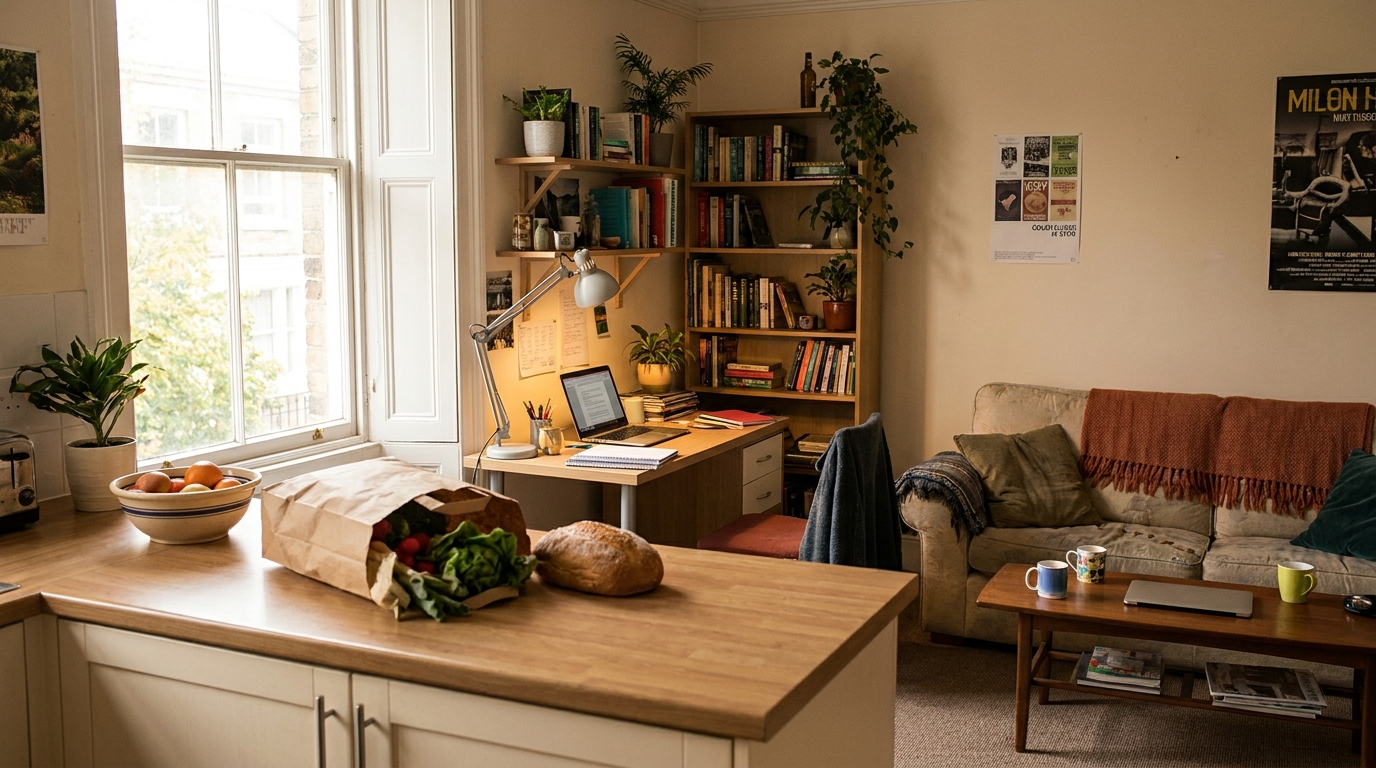
Types of student housing
Several housing types shape the cost of living in Milan for students. University halls are the cheapest and most sociable, offering basic rooms near campus with bills often included — ideal for a first year. Shared flats are the most popular option, splitting rent and utilities with flatmates to keep per-person costs down while offering more space and independence.
Private studios and one-bed flats give the most privacy but cost the most, often €800–1,200 a month, and are usually unnecessary for students. Purpose-built student residences and co-living sit in between, bundling Wi-Fi, cleaning and community at a premium. Most international medical students start in halls or a shared flat. Matching the housing type to your budget and need for privacy is central to managing the cost of living in Milan for students.
The right choice often evolves over the degree. In the first year, university halls are hard to beat — cheapest, most convenient, and an instant social circle while you find your feet in a new country and city. By the second or third year, once you know Milan and have made friends, many students move into a shared flat for more space and independence, splitting rent and bills to keep the per-person cost down. Thinking about this progression in advance helps you plan the accommodation share of the cost of living in Milan for students across all six years rather than year by year.
Finding accommodation
Securing the right home early shapes the cost of living in Milan for students, and demand is high, so start months ahead. University housing fills fast — apply as soon as you can through your university's housing office, and look into regional student-housing grants. For private options, shared flats and residences appear on established rental and student-housing platforms.
Guard carefully against rental scams: never pay before viewing a property (or having a trusted person view it) and signing a proper contract, be wary of listings that look too cheap, and favour verified platforms or university-arranged housing for your first year. Expect a refundable deposit of one to two months' rent. Booking safe, fairly-priced accommodation early is the most effective way to control the largest element of the cost of living in Milan for students.
A sensible strategy is to secure university or verified accommodation for your first year before you even arrive, then use that settled base to search in person for a shared flat in later years, once you know the neighbourhoods and have potential flatmates. Viewing a property yourself, or having a trusted person view it, before paying anything is the single best protection against the rental scams that target new international arrivals in big cities. University international offices can also point you to reputable listings. This careful, staged approach protects both your money and your peace of mind in managing the cost of living in Milan for students.
Food & groceries
Food is a manageable part of the cost of living in Milan for students if you cook at home. Groceries cost around €300–350 a month, and shopping at budget supermarkets like Lidl, Conad or Coop and local markets keeps this in check. University canteens (mensa) offer cheap, subsidised meals — a great daily option.
The university mensa system is one of the genuine bargains of Italian student life and worth using fully. These canteens serve full, balanced meals at heavily subsidised prices — a fraction of what an equivalent meal would cost in a restaurant — and DSU scholarship holders may eat free or at further-reduced rates. For a busy medical student, the mensa offers a hot, affordable lunch between lectures and hospital sessions without the time or cost of cooking midday. Building your daily eating around the mensa and home-cooked dinners is one of the simplest, most effective ways to keep food a small line in the cost of living in Milan for students.
Eating out is where Milan gets expensive: a restaurant meal in the centre can cost €40 a person (around €20 in the suburbs), and a beer about €6. Treating dining out as an occasional pleasure rather than a habit makes a big difference. With home cooking, the mensa and smart shopping, food stays affordable even in a pricey city, helping keep the overall cost of living in Milan for students under control.
Self-catering is the single biggest food saving, and it is easy to do well in Milan. A weekly shop at a discount supermarket, batch-cooking with flatmates, and using the subsidised university mensa for lunches keeps costs firmly at the lower end, while treating restaurant meals and aperitivo outings as occasional social pleasures does the rest. Italy's markets offer excellent fresh produce at fair prices, and learning to cook a few Italian staples is both economical and one of the genuine joys of living there. With these habits, food remains a modest, predictable part of the cost of living in Milan for students.
Transport
Transport is one of the more affordable parts of the cost of living in Milan for students, thanks to an excellent public network. Milan's ATM system of metro, trams and buses is comprehensive, and a student travel pass costs roughly €35–60 a month — far less than the full adult fare and giving unlimited city travel.
The metro makes living slightly outside the centre practical, letting you trade lower rent for a short commute. Milan is also walkable and cycle-friendly, and bike- and scooter-sharing schemes are cheap for occasional trips. Because the network is so good, students rarely need a car or taxis. This efficient, affordable transport is a genuine quality-of-life benefit and helps offset the higher cost of living in Milan for students elsewhere.
The practical upshot is that most students never need a car, which would add insurance, parking and fuel to an already pricey city. The ATM student pass covers unlimited travel across the metro, tram and bus network for a modest monthly sum, and the system runs late and frequently. Combined with Milan's walkability in the centre and cheap bike- and scooter-sharing for occasional trips, this means getting around is one area where Milan is genuinely affordable. Over six years, this efficient, low-cost mobility makes a real, cumulative difference to the cost of living in Milan for students.
Utilities & connectivity
Utilities and internet form a modest but real part of the cost of living in Milan for students. In a shared or private flat, budget roughly €100–150 a month for electricity, heating, water and internet combined (often more in winter for heating); halls frequently include some bills. Always check whether utilities are included before signing a contract, as many landlords charge them on top.
Connectivity is good and inexpensive: a local SIM with calls and data costs around €10–15 a month, and home broadband is reasonable. Utility costs in Milan are generally cheaper than in much of northern Europe. Getting an Italian SIM on arrival avoids roaming charges. Factoring utilities into your accommodation choice gives an accurate picture of the cost of living in Milan for students.
The one seasonal swing to anticipate is winter heating, which pushes bills toward the upper end of the range from late autumn through early spring — which is why utilities are given as a band. In halls this is often bundled into the rent; in a private or shared flat you have some control through sensible use. The crucial habit is to confirm, before signing any contract, exactly which utilities are included and which are charged on top, since this can change the real monthly cost substantially. Reading the small print on utilities is a simple way to avoid an unwelcome surprise in the cost of living in Milan for students.
Milan vs cheaper Italian cities
It's worth being honest about how the cost of living in Milan for students compares with the rest of Italy: Milan is the most expensive student city in the country. Cities like Bologna, Padua, Pisa and Turin are notably cheaper — often €700–1,000 a month — and the south (Bari, Naples, Catania) cheaper still at €600–800 — comparable to student cities elsewhere in Europe such as Vilnius or Riga.
| Monthly student budget (typical) | EUR | INR | USD | GBP | AED |
|---|---|---|---|---|---|
| South / islands (Bari, Catania) | €600–800 | ₹54,000–72,000 | $648–864 | £510–680 | AED 2,400–3,200 |
| Other north/central (Bologna, Padua, Turin) | €700–1,000 | ₹63,000–90,000 | $756–1,080 | £595–850 | AED 2,800–4,000 |
| Milan (priciest) | €1,100–1,800 | ₹99,000–1.62L | $1,188–1,944 | £935–1,530 | AED 4,400–7,200 |
If budget is your top priority, a cheaper Italian city delivers the same EU-recognised degree for considerably less. But Milan's higher cost buys advantages others can't match, as the next section explains. Weighing the cost of living in Milan for students against these alternatives is a key part of choosing where to study. Our cost guide and pillar cover the cheaper cities in detail.
The honest comparison matters because the degree itself is broadly equivalent across Italy's public universities — the same EU-recognised MD, the same IMAT route, the same global recognition. So a student choosing Bologna, Padua, Turin or Bari over Milan sacrifices nothing in the qualification, only in the particular advantages of the big city, while saving meaningfully on living costs over six years. For budget-conscious families, that is a powerful argument, and it is why many international students deliberately target Italy's cheaper cities. Weighing this trade-off clearly is central to deciding whether the cost of living in Milan for students is worth it for you.
A balanced way to decide is to ask what you most want from your six years. If your priority is the lowest possible cost, a southern or smaller-northern city wins comfortably. If it is the strongest clinical and research environment, the richest cultural life, and the connections of a major metropolis — and your budget can stretch — Milan earns its premium. There is no universally right answer; it depends on your finances and your goals. What matters is making the choice deliberately, with clear eyes about the cost of living in Milan for students versus the alternatives, rather than by default.
For many students, the ideal solution is to keep both options genuinely open during the IMAT process by ranking a spread of universities across cities. A strong IMAT score might secure a coveted Milan seat; a more modest one might point toward an excellent, far cheaper southern university. Either outcome is a good one, and approaching the ranking with this flexibility means your eventual city — and its cost — flows from your exam performance and a clear-eyed sense of your budget. That way, whether or not you end up paying the cost of living in Milan for students, the decision is a deliberate, well-informed one.
Why choose Milan anyway
Given the cost of living in Milan for students, why do so many choose it? Because Milan offers things no cheaper Italian city can. It is Italy's economic and financial capital, with the country's best teaching hospitals and research institutions — invaluable for a medical career — and its universities are among the most prestigious and internationally connected in Italy.
Milan is also a major global city: cosmopolitan, stylish, safe, endlessly cultural, and superbly connected for European travel and future career mobility. It is home to other top universities, giving a large, diverse international student community — much as you would find in other major European study hubs like Poland. For ambitious medical students who value the best clinical training, research opportunities and a vibrant international environment — and can manage the budget — the cost of living in Milan for students is a price worth paying for the opportunities it unlocks.
For a medical career specifically, Milan's advantages are concrete rather than abstract. Training in some of Italy's most advanced teaching hospitals, exposure to cutting-edge research, and the professional networks of a major medical hub can shape the early years of a doctor's career, opening doors to competitive specialties and academic medicine. Add the soft benefits — fluency gained in a cosmopolitan environment, an international peer network, and the cultural capital of having lived in one of Europe's great cities — and many students conclude that the higher cost of living in Milan for students is an investment in their future, not merely an expense.
Culture & things to do
Milan rewards students with a cultural life that justifies part of the cost of living in Milan for students. The city is a world capital of fashion and design, with the famous Duomo, the Galleria, La Scala opera house, world-class museums and galleries, and Leonardo's Last Supper. There are theatres, cinemas, festivals and exhibitions year-round, many with student discounts.
Much can be enjoyed cheaply or free: wandering the historic centre, relaxing in the parks, window-shopping the design districts, and student-rate tickets to culture. Milan's blend of history, style and modern energy gives students an endlessly stimulating backdrop to their studies. This rich cultural life is part of what you get for the cost of living in Milan for students, and a real compensation for the higher price tag.
What makes Milan's culture especially valuable to students is how much of it is accessible cheaply. Student-rate tickets bring world-class opera, theatre and exhibitions within reach; the historic centre, parks and design districts cost nothing to enjoy; and free or low-cost events fill the calendar year-round. So while Milan has a reputation for luxury and high fashion, students quickly discover a parallel, affordable city of museums, parks, markets and cultural events. Tapping into this accessible side of Milanese culture is a wonderful, low-cost counterweight to the cost of living in Milan for students.
Nightlife & socialising
Milan has a vibrant, fashionable social scene that fits a range of budgets despite the overall cost of living in Milan for students. The city is famous for its aperitivo culture — early-evening drinks served with generous food, often the best-value way to eat and socialise. Areas like the Navigli canals and Brera buzz with bars, cafés and restaurants where students gather.
Beyond nightlife, there's a busy calendar of student events, society gatherings, live music and seasonal festivals. While a night out in central Milan can be pricey, students quickly learn the affordable spots, aperitivo deals and student nights that keep socialising fun without breaking the budget. A lively social life is very much part of the experience behind the cost of living in Milan for students.
The aperitivo tradition deserves special mention as a student's best friend in Milan. For the price of a single drink — typically a few euros more than a plain beverage — many bars lay on a generous buffet of food in the early evening, effectively combining a social outing with dinner at modest cost. Learning the neighbourhoods and venues with the best aperitivo spreads is a rite of passage, and a genuinely economical way to eat and socialise. This kind of local knowledge, picked up quickly from fellow students, is exactly how newcomers learn to enjoy Milan fully while keeping the cost of living in Milan for students in check.
Safety & healthcare
Safety is a strong point that adds value to the cost of living in Milan for students. Milan is a safe city by global standards (scoring well on international safety indices), and students feel comfortable getting around, though normal big-city precautions against pickpocketing in crowded tourist areas are sensible.
On healthcare, international students need health insurance (required for the visa and enrolment); private cover is inexpensive for the first months before any public-system access, and Milan's hospitals are among Italy's finest. Pharmacies are plentiful. Budget a modest sum for insurance and occasional medical costs. The combination of a safe environment and excellent healthcare underpins the quality of life behind the cost of living in Milan for students.
It is reassuring for medical students in particular to be training in a city with such strong healthcare infrastructure — Milan's hospitals are among the best in Italy, which benefits both your clinical education and your own access to care if needed. On day-to-day safety, the sensible precautions are the universal big-city ones: keep an eye on belongings in crowded tourist spots and on public transport, and use normal awareness at night. With those habits, students find Milan a comfortable, secure place to live, and its safety is a real, if intangible, part of the value behind the cost of living in Milan for students.
Weather & seasons
Milan's climate shapes daily life and, slightly, the cost of living in Milan for students through winter heating. The city has warm, humid summers and cold, foggy winters, with pleasant spring and autumn months. It can feel grey in deep winter, though the Alps and Italian lakes are close for weekend escapes.
Students from warmer climates should budget for good winter clothing and expect a real seasonal swing. The main cost impact is higher heating bills in winter. None of this is extreme, and the mild shoulder seasons are lovely. Planning for the seasons — warm layers for winter, lighter clothes for humid summers — is a small but practical part of settling into the cost of living in Milan for students comfortably.
Each season has its compensations. The cold, sometimes foggy winters are offset by cosy cafés, the festive season and easy access to the nearby Alps for skiing; the warm, humid summers are quieter in the city but ideal for weekend escapes to the Italian lakes just an hour away. Spring and autumn are genuinely lovely in Milan, with mild weather and a full cultural calendar. A modest one-off spend on good winter clothing in your first months, and an embrace of the seasonal rhythm, is all it takes to feel at home without adding much to the cost of living in Milan for students.
The proximity of the lakes and mountains is a particular gift of Milan's location that students from flatter or warmer countries come to treasure. Within an hour or two you can be hiking or swimming at Lake Como, skiing in the Alps, or exploring a medieval lakeside town — affordable day or weekend trips that provide a complete change of scene from city study. These easy escapes are a real, if often unanticipated, quality-of-life benefit, and they cost little. Far from inflating the cost of living in Milan for students, this access to nature and the seasons is one of the city's most rewarding and economical pleasures.
Student community
One of Milan's great strengths barely shows up in the cost of living in Milan for students but transforms the experience: its huge, diverse international community. As a global city with many universities, Milan draws students from around the world, so international medical students arrive into a ready-made, multicultural community where English is widely spoken and no one is a permanent outsider.
Student societies, sports, cultural associations and a packed social calendar make it easy to build friendships and support networks. For students far from home, this sense of belonging eases homesickness and makes the demanding medical years genuinely enjoyable. This vibrant, welcoming community is a huge, almost free, part of the value behind the cost of living in Milan for students.
The practical benefits of this community are real and immediate. Senior students share advice on housing, budgeting, the mensa and the best aperitivo deals; national and cultural societies provide a taste of home; and the shared experience of studying medicine abroad forges close, lasting friendships. Universities run orientation programmes and buddy schemes to help newcomers settle, and the sheer scale of Milan's student population means there is always someone who has navigated whatever you are facing. For anyone anxious about moving to a major foreign city alone, this ready-made network is deeply reassuring — and it costs nothing, quietly multiplying the value behind the cost of living in Milan for students.
This community dimension is one reason many students find that the experience of living in Milan exceeds what the raw budget figures might suggest. The friendships formed across nationalities, the shared adventures exploring Italy and Europe, the professional networks built in a major medical hub — these intangibles are a large part of what you are really paying for, and they pay dividends long after graduation. When students reflect on whether the cost of living in Milan for students was worthwhile, it is very often these human and experiential returns, as much as the academic ones, that make them answer yes.
Ultimately, student life in Milan is the proof that a higher cost can still represent strong value when it buys genuine opportunity. The city gives international medical students Italy's best clinical training, a safe and stylish base, a global peer group, unrivalled European connectivity, and a quality of life that many remember as among the best years of their lives. For students whose budgets can stretch to it, that combination is precisely why the cost of living in Milan for students, though Italy's highest, is so often judged money well spent.
Working part-time
Part-time work can help offset the cost of living in Milan for students. International students on a study residence permit may generally work limited hours (commonly up to around 20 a week in term, more in holidays), and Milan — as a big, business-driven city — offers more casual jobs in hospitality, retail, tutoring and events than smaller towns.
That said, medicine is demanding, so part-time work is best treated as a supplement rather than a financial pillar, most feasible in the earlier years and holidays before clinical rotations intensify. Some Italian helps widen the jobs available, though Milan's international scene offers English-friendly roles too. Used sensibly, part-time earnings are a practical way to ease the cost of living in Milan for students without compromising studies — but shouldn't be relied on to fund the whole degree.
Be realistic about timing, though. The first year, with its heavy science load, and the later clinical years, with long hospital hours, leave little room for regular work; the gentler middle stretches and the long summers are when part-time jobs fit best. Milan's size and business focus do mean more opportunities than a small university town offers, from hospitality and retail to tutoring and event work, and the international scene creates English-friendly roles. Treated as a welcome top-up at the right moments rather than a financial foundation, part-time work is a useful tool for easing the cost of living in Milan for students.
Travel around Europe
Milan's connectivity adds value well beyond the cost of living in Milan for students. The city has three airports and is a major rail hub, putting the rest of Italy and Europe within easy, affordable reach. High-speed trains whisk you to Rome, Florence, Venice and Turin; budget flights and trains connect to France, Switzerland, Germany and beyond.
The Italian lakes (Como, Maggiore), the Alps for skiing, and countless historic cities are short trips away. As part of the Schengen Area, Italy lets you travel freely across most of Europe. This makes weekend and holiday travel realistic on a student budget — a genuine perk that partly offsets the higher cost of living in Milan for students and enriches your time abroad enormously.
Within Italy, too, there is endless cheap exploration on Milan's doorstep: the lakes of Como and Maggiore, the Alpine resorts, and historic cities like Verona, Bergamo and Turin are all short, inexpensive trips. The high-speed rail network puts Florence, Venice, Bologna and Rome within a few hours, perfect for weekend breaks. Internationally, Milan's three airports offer budget flights across Europe, and the Schengen Area means no border friction. For curious students who want to see the continent while they study, this connectivity is a major, life-enriching perk that helps justify the cost of living in Milan for students.
Banking & everyday admin
Settling in smoothly helps manage the cost of living in Milan for students from the start. You'll need a codice fiscale (Italian tax code) for almost everything — enrolment, a bank account, a phone contract, renting — so obtain it early. Opening a local euro bank account avoids foreign-transaction fees, and an Italian SIM gives cheap calls and data without roaming.
Keep digital and physical copies of key documents — passport, permesso di soggiorno, insurance, enrolment letter — for the various registrations. Italy can be bureaucratic, so allow time for paperwork and ask your university's international office for help. Getting this everyday admin sorted early removes friction and hidden costs, and is a small but real part of managing the cost of living in Milan for students efficiently.
A practical tip is to tackle the essential registrations in a sensible order on arrival — codice fiscale first, since almost everything else depends on it, then residence registration, a bank account, a SIM and your transport pass. Italy's bureaucracy can be slow, so patience and good document organisation help, and your university's international office is an invaluable guide through the local procedures. Getting this sequence right in your first weeks means less time and money lost to administrative tangles later, supporting a well-managed cost of living in Milan for students from the very start.
Study & lifestyle balance
Medical school is intense, so protecting your wellbeing matters as much as managing the cost of living in Milan for students. Happily, Milan makes balance achievable: affordable gyms and sports facilities, parks for running and relaxing, and the famous aperitivo and café culture all offer ways to unwind without overspending.
The excellent transport and the city's compact core make it easy to switch off between study blocks — a museum visit, a walk in the park, a cheap weekend trip to the lakes or mountains. Joining a society or sports team builds friendships and keeps the long degree sustainable. This achievable work-life balance, even in a busy city, is one of the quieter rewards bundled into the cost of living in Milan for students.
Maintaining this balance is a necessity, not a luxury, in medicine, where burnout is a genuine risk. Milan's abundance of accessible outlets — sport, parks, culture, socialising and easy weekend escapes — makes it straightforward to build the healthy routines that sustain you through exams and rotations, and most cost little. Students who use the city this way tend to be happier and more resilient. In that sense the lifestyle Milan affords is not separate from its cost but woven into it: much of what keeps you well here is affordable, which softens the overall cost of living in Milan for students.
It is worth emphasising for prospective medical students that this balance is not a distraction from study but a support for it. The six-year course is a marathon, and the students who sustain their wellbeing — through exercise, friendships, culture and rest — tend to perform better and burn out less. Milan makes this achievable affordably, which means looking after yourself need not inflate your budget. In that light, the lifestyle the city offers is part of the value proposition, not a competing expense, and it reframes how to think about the cost of living in Milan for students over the long haul of a medical degree.
Money-saving tips
Several habits keep the cost of living in Milan for students at the lower end. The biggest wins: live in halls or a shared flat (not alone), and consider an area slightly outside the centre near a metro line to cut rent 20–30%. Then cook at home, use the university mensa, and shop at Lidl, Conad or Coop.
Beyond that, get the ATM student travel pass, use student discounts everywhere (carry your ID, consider an ISIC card), make the most of aperitivo for good-value food and drink, buy second-hand books, open a local bank account and get an Italian SIM. Apply early for any regional student-housing grants. Stacking these savings brings the cost of living in Milan for students down significantly — many students live well nearer €1,100 than €1,800.
None of these habits requires real sacrifice — they are simply the smart defaults experienced Milan students adopt. Choosing halls or a shared flat near a metro line, cooking at home, using the mensa and the student travel pass, and enjoying aperitivo and student discounts are normal parts of life here, not hardships. Adopted from the start, they reliably keep a student's monthly spend toward the lower end of the range, leaving room to enjoy the city and travel. That is the practical promise of budgeting well: the cost of living in Milan for students can be far gentler than the headline figures suggest, with no loss of the Milan experience.
The encouraging bottom line is that the headline range is wide precisely because so much is within your control. By making smart choices on the big-ticket items — accommodation type and location above all, then food and transport habits — a determined student can live comfortably in Milan toward the lower end of the range, freeing budget to enjoy the city and travel. With a little planning and the local know-how that fellow students share freely, the cost of living in Milan for students becomes not a barrier but simply the practical foundation of a rich and rewarding time in one of Europe's great cities.
Thousands of international students thrive in Milan each year, and there is no reason you cannot be one of them. With realistic budgeting, an early plan for housing and admin, and a willingness to embrace the city's affordable pleasures, the financial side of studying here is entirely manageable — and the experience it buys is one you are likely to treasure.
How EHEC helps
EHEC helps you plan realistically for the cost of living in Milan for students — budgeting accommodation, food and daily costs, finding safe verified housing, arranging health insurance, sorting your codice fiscale and bank account, and weighing Milan against Italy's cheaper student cities. We make settling into a new city clear and manageable, so you can focus on your studies.
Book a free 45-minute consult →
Related guides
- Student life in Cyprus
- Student life in Greece
- Student life in Hungary
- Student life in Slovakia
- Study medicine in Italy: the complete guide
- Cost of studying medicine in Italy
- Medicine in Italy admission: the IMAT & how to apply
- Practising after an Italy medical degree
- Student life in Lithuania: living in Vilnius (comparison)
- Student life in Latvia: living in Riga (comparison)
- Study medicine in Poland
- Study medicine in English in Europe
- Study MBBS abroad: the complete guide
- Studying medicine abroad as a US student
- Comparison of leading European destinations
- University of Milan
- University of Milan–Bicocca
- Explore Italy
Frequently asked questions
What is the cost of living in Milan for students?
Roughly €1,100–1,800 a month including rent — about €512 excluding rent — with €1,255 a typical figure. It's Italy's most expensive student city. The exact amount depends mainly on your accommodation and lifestyle, with halls and shared flats at the lower end.
How much is student accommodation in Milan?
Student housing ranges from about €500 to €1,200 a month. University halls are cheapest (~€350–600), a room in a shared flat is typically €450–700, and a private studio €800–1,200. Living slightly outside the centre near a metro line can cut rent by 20–30%.
How much should I budget for food?
Around €300–350 a month cooking at home and shopping at budget supermarkets like Lidl, Conad or Coop, plus the cheap university mensa. Eating out is pricey — about €40 a meal in the centre — so treat it as an occasional treat to keep costs down.
How much is public transport in Milan?
An ATM student travel pass costs roughly €35–60 a month for unlimited metro, tram and bus travel — far less than the adult fare. The excellent network makes living slightly outside the centre practical, trading lower rent for a short commute.
Is Milan more expensive than other Italian cities?
Yes — Milan is Italy's most expensive student city. Bologna, Padua, Pisa and Turin are cheaper (around €700–1,000 a month), and the south (Bari, Naples, Catania) cheaper still (€600–800). The same EU-recognised degree costs far less in those cities.
Why study in Milan if it's so expensive?
Milan is Italy's economic capital with the best teaching hospitals, research and international connections, plus a safe, stylish, cosmopolitan lifestyle and superb European links. For ambitious medical students who can manage the budget, those opportunities justify the higher cost.
Is Milan safe for international students?
Yes — Milan scores well on global safety indices and students feel comfortable, though normal big-city precautions against pickpocketing in crowded areas are wise. The large international community helps newcomers settle in quickly.
Do I need health insurance?
Yes — it's required for the student visa and enrolment. Private cover is inexpensive for your first months before any public-system access, and Milan's hospitals are among Italy's best. Keep your cover continuous throughout your studies.
Can I work part-time in Milan?
Yes — students on a study residence permit can generally work limited hours (around 20 a week in term, more in holidays), and Milan offers more casual jobs than smaller cities. Treat it as a supplement, not a financial pillar, as the medical course is demanding.
How can I reduce the cost of living in Milan?
Live in halls or a shared flat slightly outside the centre near a metro line, cook at home and use the mensa, get the ATM student pass, use student discounts and aperitivo deals, buy second-hand books, and apply early for regional student-housing grants.
Want this applied to your own profile? Book a free 45-minute consult and a senior counsellor will map exactly what it means for you, your timeline, and your budget.