Living in Pécs
Housing, costs, visa and arrival
A dormitory room, a bus pass and a canteen lunch add up to one of the lowest monthly budgets for an EU university city. The figures below are the university's own, shown in the five currencies EHEC students budget in.
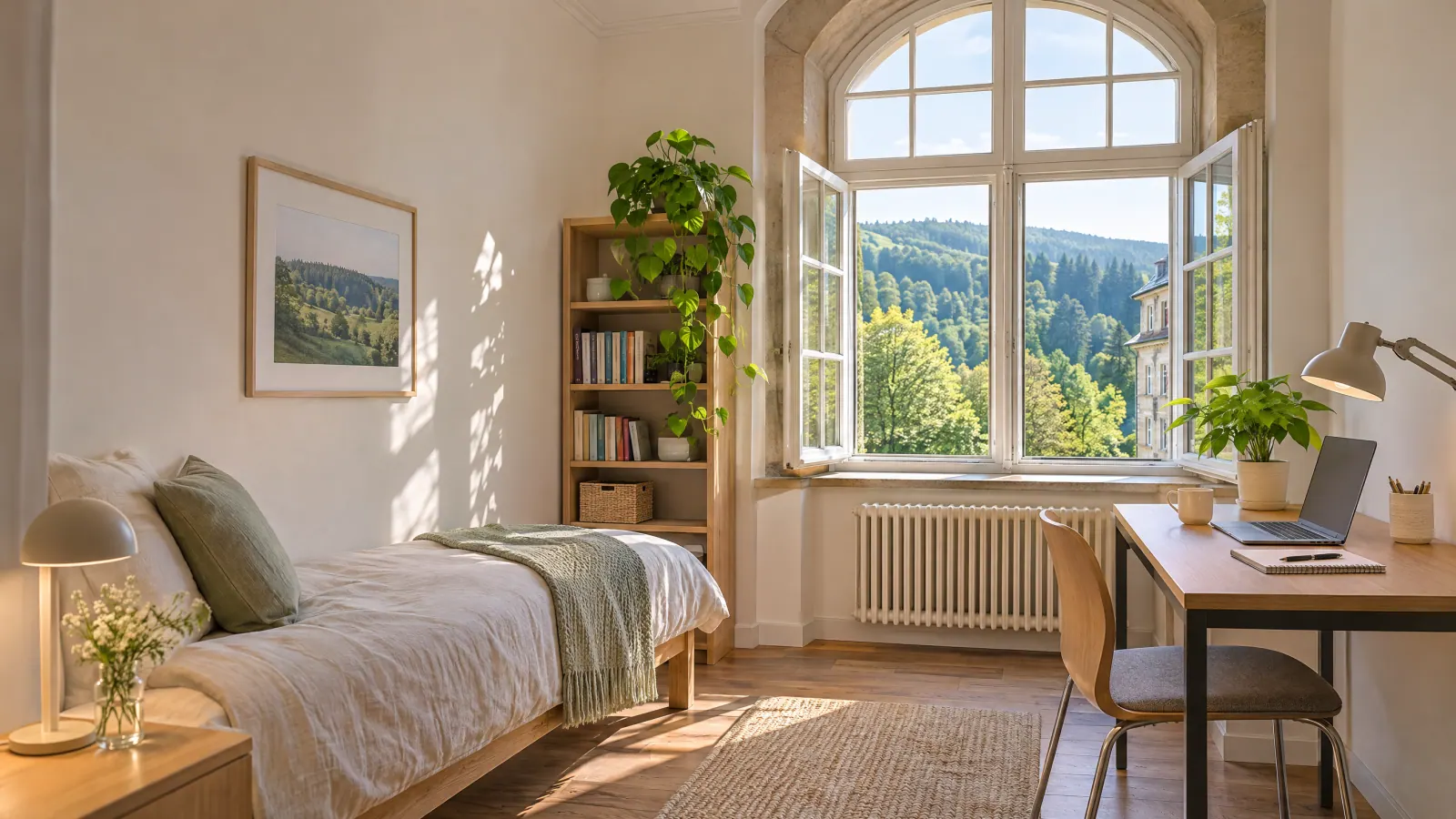
Dormitory fees per month
| Dormitory | EUR | INR | USD | GBP | AED | HUF |
|---|---|---|---|---|---|---|
| Szántó Dormitory, wings A and C | €256 | ₹26,600 | $284 | £214 | AED 1,040 | HUF 93,300 |
| Szántó Dormitory, wing D | €219 | ₹22,800 | $243 | £183 | AED 894 | HUF 79,900 |
| Damjanich Dormitory | €284 | ₹29,600 | $316 | £237 | AED 1,160 | HUF 104,000 |
| Balassa Dormitory | €219 | ₹22,800 | $243 | £183 | AED 894 | HUF 79,900 |
HUF as published by the university; other currencies at EHEC's fixed rate of 12 Nov 2026.
Dormitories
The university runs ten dormitories in quiet residential districts, most of them renovated in recent years, with the faculties and the centre a short bus ride away. Places are limited and allocated through the Student Union's annual application, so ask for one as soon as you accept your offer. Scholarship holders are placed first.
Rooms come with internet, and the buildings have study rooms, lounges, a cafeteria, bike storage, parking and a student club. Bring your own kitchenware, towels, bedsheets, washing powder, a drying stand and a network cable; check in with your passport, proof of admission and the first month's rent, which must be paid before you move in.
Renting a flat
A two-room flat costs roughly HUF 80,000 to 200,000 a month depending on district and distance from your faculty, and sharing brings it down to HUF 80,000 to 100,000 per person. Agencies in Pécs work in English and the Medical School has an official housing partner that arranges viewings by car.
Your rental contract matters for immigration: it must name the address, the monthly cost, the term and the landlord, and it has to meet the immigration office's format. An English translation is strongly advised. You will also need the property deed copy, utility details and the address registration form from the landlord.
Cost of living, item by item
| Item | EUR | INR | USD | GBP | AED | HUF |
|---|---|---|---|---|---|---|
| Food | ||||||
| Meal in the university canteen | €7–10 | ₹729–1,040 | $7.8–11 | £5.9–8.4 | AED 29–41 | HUF 2,500–3,500 |
| Meal in a restaurant | €11–23 | ₹1,180–2,370 | $13–25 | £9.5–19 | AED 46–93 | HUF 4,000–8,000 |
| One litre of milk | €0.9–2 | ₹89–208 | $0.9–2.2 | £0.7–1.7 | AED 3.5–8.2 | HUF 300–700 |
| One bottle of beer | €1.4–4.3 | ₹148–444 | $1.6–4.7 | £1.2–3.6 | AED 5.8–17 | HUF 500–1,500 |
| One bottle of red wine | €2.8–7 | ₹296–729 | $3.2–7.8 | £2.4–5.9 | AED 12–29 | HUF 1,000–2,500 |
| One litre of bottled water | €0.3–0.5 | ₹31–52 | $0.3–0.6 | £0.3–0.4 | AED 1.2–2 | HUF 200–350 |
| One loaf of bread | €1.7–3.4 | ₹177–354 | $1.9–3.8 | £1.4–2.8 | AED 6.9–14 | HUF 600–1,200 |
| Transport | ||||||
| One litre of petrol | €1.8 | ₹184 | $2 | £1.5 | AED 7.2 | HUF 624 |
| Monthly bus pass (student) | €12 | ₹1,210 | $13 | £9.7 | AED 48 | HUF 4,100 |
| Single bus ticket from a kiosk | €1.4 | ₹148 | $1.6 | £1.2 | AED 5.8 | HUF 500 |
| Single bus ticket from the driver | €1.7 | ₹178 | $1.9 | £1.4 | AED 7 | HUF 600 |
| One-way InterCity train to Budapest (student) | €8.4 | ₹879 | $9.4 | £7.1 | AED 34 | HUF 2,970 |
| Taxi within the city | €5–10 | ₹521–1,040 | $5.6–11 | £4.2–8.4 | AED 20–41 | HUF 1,800–3,500 |
| Airport shuttle, Budapest to Pécs, one way | €46 | ₹4,740 | $51 | £38 | AED 186 | HUF 17,000 |
| Entertainment | ||||||
| Entrance to a party | €0–17 | ₹0–1,770 | $0–19 | £0–14 | AED 0–69 | HUF 0–6,000 |
| Cinema ticket (student discount) | €7.1–8.5 | ₹740–889 | $7.9–9.5 | £5.9–7.1 | AED 29–35 | HUF 2,500–3,000 |
| Theatre ticket (student discount) | €7.1–17 | ₹740–1,770 | $7.9–19 | £5.9–14 | AED 29–69 | HUF 2,500–6,000 |
| Swimming pool University pools are free for students | €4.6–7.1 | ₹474–740 | $5.1–7.9 | £3.8–5.9 | AED 19–29 | HUF 1,600–2,500 |
| Ice skating (student discount) | €3 | ₹312 | $3.3 | £2.5 | AED 12 | HUF 1,100 |
| Accommodation | ||||||
| Private flat per month Depends on location and number of tenants | €285–715 | ₹29,700–74,500 | $317–795 | £238–598 | AED 1,160–2,920 | HUF 100,000–250,000 |
| Shared flat per month, per person | €230–285 | ₹24,000–29,700 | $256–317 | £192–238 | AED 939–1,160 | HUF 80,000–100,000 |
| Dormitory per month | €180–235 | ₹18,700–24,500 | $200–261 | £150–196 | AED 735–959 | HUF 72,600–94,100 |
HUF and EUR figures as published by the university on 11 Nov 2026. USD, GBP, INR and AED are converted from the EUR figure at EHEC's fixed rate of 12 Nov 2026 and rounded; they are a planning guide, not a quote. A realistic monthly budget with a dormitory room is EUR 500 to 700.
Who needs a visa
Citizens of EU and EEA countries and Switzerland enter freely and register locally after arrival. Everyone else staying more than 90 days, which means every full degree, needs a D-type long-stay visa and a residence permit for the purpose of studies before travelling. Nationals of visa-exempt countries such as the UK, the USA, Canada, Australia, Brazil and the Gulf states can enter for 90 days without a visa but still need the residence permit for study.
What the consulate asks for
The application is lodged in person at the Hungarian embassy or consulate for your country of citizenship or legal residence, and processing takes several weeks, so start as soon as the Letter of Admission arrives.
- Completed residence permit application form, in English or Hungarian
- Passport valid at least three months beyond the stay
- One recent passport photo
- Letter of Admission from the university
- Proof of accommodation: dormitory confirmation or a compliant tenancy agreement
- Proof of funds for living costs, or your scholarship letter
- Health insurance valid in Hungary
- Means to leave the EU if the permit is refused (return ticket or funds)
After you land
Within days of arrival you complete the process on the Enter Hungary platform by registering your address with the National Directorate-General for Aliens Policing. The residence card is posted to the university and you collect it when the international office e-mails you. It is your legal proof of stay for the whole degree, so keep it safe and renew it before it expires.
Scholarship holders and most students then open a Hungarian bank account, apply for the student card that unlocks transport and cultural discounts, and register with a GP through the university's medical care service.
Health insurance
Full health cover valid in Hungary is a condition of enrolment at every faculty. Emergency care is free for everyone; anything else is paid for unless you are insured. EU students can use the European Health Insurance Card for medically necessary care, but the university still advises private cover.
Non-EU students have two routes. The university recommends a fee-for-service student policy from an insurer it has a contract with, which you buy in person in the first week of September and which settles hospital bills directly. The alternative is the Hungarian social security card, applied for at the local health insurance fund with your registration card, address proof and enrolment certificate, at a monthly contribution the university last quoted at HUF 38,250. Stipendium Hungaricum and other state scholarship holders receive the social security card free.
For the visa itself a short travel policy covering the journey and the first days is enough; the student policy takes over after enrolment.
Getting to Pécs
Fly to Budapest. From the airport the simplest option is a shared shuttle minibus straight to Pécs, about two and a half hours door to door and roughly HUF 9,000 to 17,000 depending on the operator; two companies run the route and the university does not book it for you. The train from Budapest Keleti station takes around three hours on the InterCity and costs under HUF 3,000 with a student discount.
Pécs is in the south of Hungary, 30 kilometres from the Croatian border and 200 from Budapest. Students use the weekend trains for Budapest and the regional buses for Zagreb, Vienna and Bratislava.
The city
Pécs is Hungary's fifth-largest city, with 2,000 years of history from Roman Sopianae to its Ottoman mosque on the main square, early Christian tombs on the UNESCO World Heritage list, and the Zsolnay porcelain quarter now turned into a cultural campus. It was European Capital of Culture in 2010, and the Kodály Centre concert hall, a dozen museums and a year-round festival calendar came out of that.
The climate is temperate with cold, sometimes snowy winters and hot summers; the Mecsek hills above the city are a short walk for hiking and winter sledging. The university's own line is that the city is small enough to feel cosy and big enough to keep you busy, and students who have lived there tend to agree.
Get the pre-departure checklist
Dormitory, insurance, Enter Hungary and the first-week errands in one list.